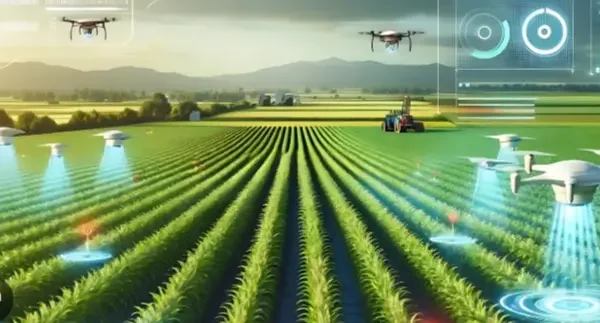
AI enhances crop production by aligning inputs with crop needs across time and space. It quantifies soil moisture, nutrients, and microclimate to inform precise irrigation and balanced fertilization. Real-time monitoring flags anomalies and outputs decision-ready guidance like irrigation schedules and pest indicators. Autonomous operations reduce labor costs while maintaining accuracy. ROI tracking and risk management frame scalable yield gains, but the effectiveness depends on data quality, system integration, and on-farm practices that may vary by context.
How AI Boosts Yield Through Precise Resource Management
AI-driven precision resource management optimizes yield by aligning inputs with crop needs across space and time. The approach quantifies soil moisture, nutrient availability, and microclimate, enabling targeted applications.
Precision irrigation reduces water stress and runoff, while nutrient optimization balances uptake with demand. Field data demonstrates improved efficiency, lower input waste, and resilient growth, supporting growers pursuing autonomy and sustainable productivity.
From Field Data to Actionable Decisions: AI-Powered Monitoring and Alerts
Field data from precision management systems informs real-time monitoring and alerting, translating measurements of soil moisture, nutrient status, and microclimate into timely situational awareness. AI aggregates signals to identify anomalies, guide interventions, and trigger alerts for field personnel.
Precision irrigation schedules, pest surveillance indicators, and crop stress metrics translate into actionable decisions, enhancing resilience while preserving autonomy and operational freedom.
See also: calmwires
Automating Labor-Intensive Tasks With AI-Driven Machinery
Automating labor-intensive tasks with AI-driven machinery streamlines field operations by converting sensor data and real-time imagery into autonomous actions. Automated Labor initiatives leverage AI Machinery to perform critical workloads with minimal human input. Data Driven Harvesting accelerates crop handling, while Autonomous Weeding reduces chemical reliance. The approach favors scalable, precise tasks, enabling freedom-oriented growers to optimize efficiency without sacrificing yields.
Evaluating ROI: Costs, Benefits, and Risk Reduction With AI in Farming
Assessing ROI in AI-enabled farming requires a disciplined accounting of costs, benefits, and risk mitigation across the production cycle. ROI evaluation focuses on input savings, yield stability, and decision-support value, while upfront CAPEX and ongoing OPEX are tracked. Field data quantify risk mitigation, including pest, drought, and disease resilience, enabling transparent comparisons across technologies and management practices.
Frequently Asked Questions
How Secure Is Farm Data When Using AI Tools?
Data privacy and cybersecurity threats frame farm tool security; the assessment shows multi-layer protections, ongoing risk monitoring, and transparent governance. In practice, data handling must emphasize access controls, encryption, regular audits, and farmer-centric, defensible privacy standards.
Can AI Replace Human Expertise Entirely in Farming?
An AI cannot fully replace human expertise in farming. A hypothetical vineyard study shows AI support complements intuition, reducing risk while sailors balance AI vs. intuition. Technology dependency vs. experience remains a dynamic tension shaping outcomes.
What Upfront Costs Are Typical for AI Systems?
Upfront costs for AI systems vary by scale but typically include hardware, sensors, software licenses, and integration services. In field contexts, total expenditures range from moderate to high, reflecting data security investments and ongoing maintenance for security farming.
How Do AI Tools Scale for Small Farms?
AI adoption scales unevenly for small farms; cost benefit analysis shows modest upfront investments, scalable tooling, and robust data governance. Farming scalability relies on modular platforms, affordable sensors, and transparent governance to sustain value and freedom in operations.
What Training Is Required to Use AI in Farming?
Training requirements vary by tool but typically include basic data literacy, field calibration, and model interpretation. Adoption challenges involve infrastructure access and ongoing support, while participants value evidence-based results and scalable, freedom-oriented decision-making within farm operations.
Conclusion
AI-driven farming translates field data into precise actions, optimizing water, nutrients, and timing to raise yields while trimming inputs. In a representative case, a mid-size corn operation reduced irrigation by 22% and achieved a 6% yield increase after implementing sensor-driven scheduling and real-time alerts. The approach mitigates risk through continuous ROI tracking and anomaly detection, enabling scalable improvements across cycles. Overall, data-centric automation fosters resilient, cost-effective production with measurable, field-proven outcomes.